The Room Is an Instrument Too: Why Acoustics Change What We Hear
Room acoustics change what we hear by shaping reflections, decay, and clarity. Learn why a performance feels different in a hall, bedroom, or kitchen.
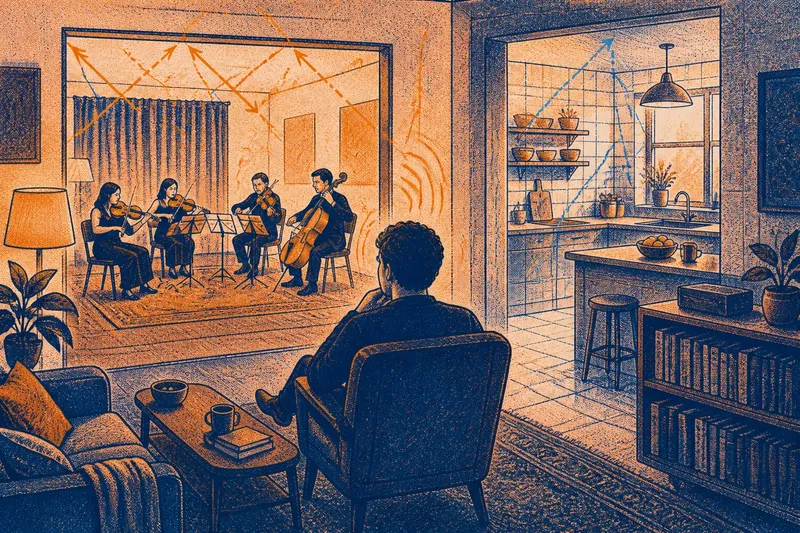
You hear a singer more clearly near the front of a small carpeted room, then move into a tiled kitchen and notice the voice seems brighter and more exposed. Room acoustics change what we hear by adding reflections and absorbing some parts of the sound.
A room is not a neutral container. Its size, shape, surfaces, and contents affect the sound reaching your ears. Understanding those effects helps explain why a string quartet can feel intimate in one space and distant in another, even when the players perform the same piece.
Sound in a room
A speaker or instrument sends sound outward in waves. Some travel directly to your ears. Others reach a wall, floor, ceiling, window, or piece of furniture and bounce back. Those reflected sounds arrive slightly later than the direct sound, and your hearing combines them into one experience.
In a room, you usually hear a mixture of direct sound and many reflections. The balance matters. Strong direct sound tends to make details and attacks easier to locate. Reflections add a sense of space and can make a sound seem fuller. If reflections arrive too prominently or persist too long, they can blur words, soften rhythmic edges, or make separate notes seem crowded.
That mix is part of the room’s character. It is also why a recording played through the same speakers can sound different in a bedroom, a living room, and a community hall.
Hard and soft surfaces
Hard, smooth surfaces such as glass, tile, and bare plaster tend to reflect sound. A clap in a tiled bathroom may leave a noticeable tail; a clap in a room with curtains and upholstered furniture often fades more quickly. The difference is not simply “loud” versus “quiet.” The returning sound shapes tone, timing, and a listener’s sense of distance.
Soft or porous materials, including thick curtains, rugs, and fabric furniture, absorb some sound energy. They can reduce the strength of reflections, especially in parts of the sound they are suited to absorb. A rug may help with sharp reflections from a bare floor, but it will not make every room sound dry or treat every frequency equally.
Large, heavy objects and irregular surfaces can also affect how sound travels. A bookcase filled unevenly with books presents a less uniform surface than a flat wall. That does not make it a precision acoustic treatment, but it can scatter some reflections rather than sending them back in one strong, concentrated direction.
Absorption and scattering are different. Absorption reduces reflected energy; scattering redirects it in several directions. A room with too little absorption can sound lively and indistinct, while a room covered in soft material can feel unnaturally subdued. The useful balance depends on the room and the kind of listening.
Why sound lingers
After a note stops, reflections may continue to arrive. The fading trail is called reverberation. A little reverberation can connect musical tones and lend a voice or instrument a sense of presence. A long, dense trail can make fast passages harder to follow, especially when notes overlap before earlier reflections have faded.
Reverberation is not the same as a distinct echo. An echo is a reflection clear enough to be heard as a separate repeat. In an ordinary room, reflections often arrive close together and blend into a general sense of space instead. A large hall may produce a longer, more noticeable decay than a small furnished room, but room size alone does not determine the result.
The shape and surfaces matter too. Parallel walls can send reflections back and forth along similar paths. An angled ceiling, curtains, seats, and audience members change those paths and absorb some energy. Even an empty hall can sound unlike the same hall filled with people, because bodies and clothing absorb sound.
Position changes the mix
Where you sit or stand changes the proportion of direct sound and reflections you hear. Near a performer or speaker, direct sound is often more prominent. Farther away, the room’s reflected sound can make up more of what reaches you. That can soften detail and make the source feel more distant, though the effect varies with the room and the source’s position.
Moving a small distance can also change which reflections reach you most strongly. A spot close to a wall may receive an early reflection from that surface, while another seat may receive a different mix. This is one reason people can disagree about a room’s sound without either person imagining the difference.
Imagine you are listening to a piano recording at home, and the bass notes seem boomy from the sofa. If you move to a chair away from the corner and the low notes become less overwhelming, the change suggests that your position and the room are shaping what you hear. The recording itself has stayed the same; the listening point has changed.
Room acoustics questions
Why does a voice sound clearer in some rooms?
A voice is easier to follow when its direct sound stands out and reflections do not smear consonants together. Soft furnishings and a suitable listening position may reduce distracting reflections, though they cannot remove every room effect.
Why does a large hall sound different from a bedroom?
A hall generally has more space for sound to travel and reflect before it fades, while a furnished bedroom often absorbs more sound over shorter paths. The hall’s shape, seats, audience, and finishes also matter, so size is only part of the explanation.
Can a rug improve a room’s sound?
A rug can reduce some reflections from a hard floor and make a room feel less bright or splashy. It is a modest change, not a complete solution for every echo or bass problem.
Why do the bass notes change when I move?
Low-frequency sound can build up unevenly in different parts of a room, so one seat may emphasize a note that sounds more balanced elsewhere. Try listening from another position before changing the recording or turning up the volume.
Simple listening checks
You do not need specialized equipment to notice basic room effects. Use the same short passage, at a comfortable level, and listen from a few positions. Keep the source and volume steady so the room is the main change.
- Listen to a hand clap. If the sound stops quickly, the room has little obvious lingering in that spot; if it leaves a tail or distinct repeat, try moving away from hard parallel surfaces or adding a soft furnishing and listen again.
- Compare a bare and furnished area. If the furnished area sounds less bright or the sound fades sooner, use it for listening that needs clearer detail; if the difference is small, compare seat positions instead.
- Shift your seat. If voices, bass, or percussion become easier to distinguish away from a wall or corner, keep the clearer position; if not, return to the more comfortable seat and try a different source position.
- Try a spoken recording. If consonants blur or reflections distract from speech, close a curtain or move to a less reflective position; if speech remains clear, no change may be needed.
- Listen to a short musical passage. If piano notes or hand percussion seem to run together, try a different seat; if their attacks remain distinct, keep the current placement.
- Change one thing at a time. If moving a chair or closing a curtain makes the sound more comfortable, keep that reversible change; if it makes the room feel dull or less open, undo it before trying another adjustment.
These checks describe what you hear; they do not identify every cause. A room can make one part of the sound more prominent while leaving another largely unchanged. Change one reversible feature at a time, such as closing a curtain or moving a chair, then listen again.
What not to chase
It is not worth trying to make every room sound like a concert hall or to cover every hard surface with foam. Foam panels are often limited in what they absorb, and a heavily damped room may lose the lively quality that makes music feel open. A room should suit its use: focused listening calls for clear detail, while shared everyday listening may benefit from a little warmth and spaciousness.
For ordinary listening, begin with placement and furnishings rather than treating a room as a technical project. Move the seat, close or open curtains, and notice whether the result helps you hear the music more comfortably. The best room is not always the quietest or most absorbent; it is the one whose reflections support the kind of listening you want.
Next time the same performance feels more intimate in a small room than in a hall, listen for the balance between direct sound and its reflected tail. That simple distinction makes room acoustics easier to hear, and it explains why the room is part of the performance’s character even when it never plays a note.