Before Recorded Sound: How Music Was Kept and Shared
Before recorded sound, memory, notation, and live repetition carried music between people; see how each preserved different parts of a tune.
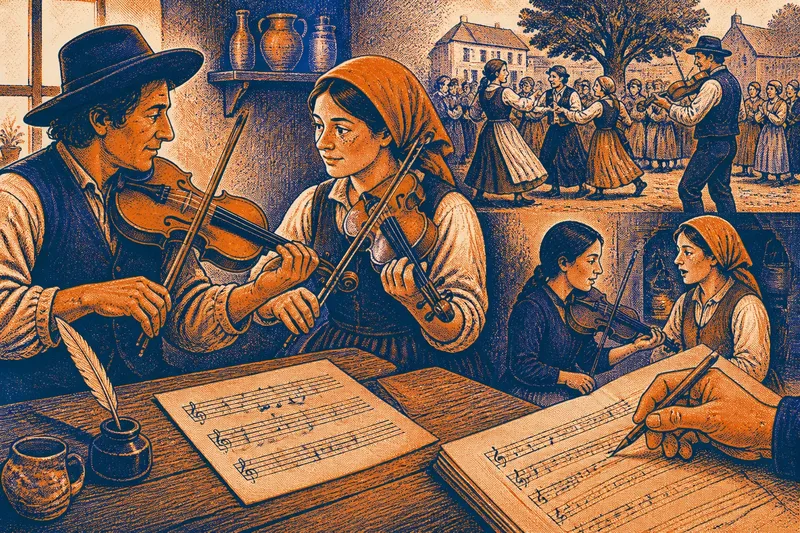
Before recorded sound, a singer might teach a tune across a kitchen table, then hear it returned with a changed ending at a neighbor’s gathering. The tune survived, but not as a fixed object: memory, notation, and live repetition each carried a different part of it.
Imagine a clearly hypothetical village where a traveling fiddler teaches a short dance melody to a baker named Mara. There is no recording to replay. Mara wants to remember the tune, teach it to her cousin, and have it ready for a community dance. Following that tune from one person to the next shows how people kept music in circulation—and why variation was part of the process, not simply a failure to preserve it.
Memory holds the tune
At the first meeting, Mara listens while the fiddler plays. She can take in the melody’s shape, but listening once does not necessarily leave her with every detail. The fiddler repeats a phrase, sings its rhythm, and plays it again. Mara joins in, first with the sung line and then on her own fiddle. Each return gives her a chance to compare what she remembers with what she just heard.
Memory is not a music box that stores a flawless copy. It favors what a person can recognize and reproduce: a rising opening, a familiar rhythmic turn, a phrase that leads naturally back to the start. Details that are hard to name or repeat may shift. A learner might keep the contour—the way the melody climbs and falls—while adjusting a small ornament, shortening a note, or settling on a slightly different pitch.
That does not make memory careless. It makes it an active form of learning. A performer builds the tune through repeated attention and bodily practice: hearing a phrase, singing it, finding it on an instrument, and recalling it later without the original player present. If the tune is used often, it can become easier to call back. If it is rarely played, uncertain passages may be replaced by the versions a person already knows.
Memory also travels with words and occasions. A tune attached to a dance, a seasonal gathering, or a familiar set of lyrics has cues that can help bring it to mind. The social setting contributes to preservation: people may remember when a piece belongs, who usually begins it, and how others respond, even when no one can state every note.
Notation marks selected details
The fiddler leaves Mara with a written tune in ordinary notation. A page can preserve useful information beyond the reach of a single memory: the sequence of pitches, a rough rhythmic pattern, and signs for pauses or repeated sections. Mara can consult it after the lesson and pass a copy to her cousin.
But a written score is not sound on paper. It represents musical choices in a system that readers must learn to interpret. The page may indicate which notes to play and how long they relate to one another, yet it cannot automatically carry every nuance of timing, tone, emphasis, or local style. A mark can suggest a performance decision without supplying the lived knowledge that makes that decision feel natural.
Different kinds of notation also serve different purposes. A fully notated score can specify many musical details for trained readers. A simpler tune written as a line of notes may function as a reminder or teaching aid, leaving performers to supply customary phrasing. Words, chord symbols, diagrams, or verbal descriptions can help too, though each captures only selected aspects of a performance.
Suppose Mara can read the pitches but has not heard the fiddler’s distinctive lift at the end of the second phrase. The notation may show the notes accurately while leaving that lift unstated. She can learn it by watching the fiddler, hearing a cousin reproduce it, or trying alternatives with other players. The page supports transmission, but it does not replace the encounter.
Notation’s strength is also a limitation: it makes some things easier to carry by fixing them in a shareable form. Once a written version exists, it can help people coordinate across distance or recall a tune after a long pause. At the same time, readers may treat its marks as more complete than they are. The most useful approach is to ask what the notation records and what the players still need to learn from one another.
Repetition teaches performance
At the community gathering, Mara plays the tune while her cousin listens. Then they switch roles. Her cousin repeats the opening, Mara supplies the next phrase, and both try the whole melody together. That exchange is more than rehearsal for a finished performance: it lets each player hear where the tune’s parts connect and where a shared convention matters.
Live repetition can communicate details a page leaves open. A teacher can slow a phrase, sing a difficult passage, point to the moment when the melody turns, and respond when a learner loses the thread. The learner can ask for another pass or imitate the teacher’s timing. Even without formal explanation, repeated playing gives people a chance to align their sense of the tune.
Group performance also reveals what a community regards as stable. Players may agree on the melody’s main outline while varying ornaments or pace. They can learn that a certain phrase should return, that one person leads a particular section, or that dancers need a clear cue. These customs are carried in action. A written instruction might help, but seeing and joining the practice gives it context.
Repetition does not always mean exact duplication. If one player adds a flourish and another leaves it out, the tune can remain recognizable. A newcomer may first copy the version heard most often, then make choices that suit their own voice or instrument. As people teach the melody onward, changes can accumulate, while familiar features keep listeners oriented.
For that reason, a living performance tradition can preserve a family of related versions rather than one untouchable original. The tune’s identity may rest in a shared melodic path, a recognizable rhythm, or the way it functions in a dance. Which features matter most depends on the people who use it and the setting in which they play.
What does each method preserve?
Can memory keep a tune unchanged?
Memory can carry a tune with striking continuity, especially when people revisit it and teach it through listening and imitation. It can also allow small changes to enter, so continuity need not mean identical performance.
Does notation capture the whole performance?
Notation can record selected features, such as pitches and rhythmic relationships, in a form people can revisit and share. It usually needs performers to interpret what is marked and learn what the page leaves unstated.
Why repeat music in person?
Live repetition lets a learner hear, imitate, and ask for clarification while the teacher can respond to what the learner does. It also passes on timing, phrasing, and social cues that may be difficult to express fully in writing.
Can a changing tune still be the same tune?
Often, yes: people may recognize a melody through its main shape or customary role even when performers alter small details. The answer depends on which features a particular community treats as central.
A tune’s changing route
Return to the imagined gathering. Mara’s cousin has learned the melody from both the page and Mara’s playing. At the next dance, the cousin starts the tune from memory. Mara joins in, and the pair make a small adjustment to suit the way the dancers are moving. The melody is recognizable, the written notes remain available, and the actual performance now includes choices neither source can make on its own.
This invented situation offers a practical way to think about transmission: ask what each handoff contributes. Memory makes the tune available inside a person. Notation gives certain details a durable, shareable shape. Live repetition teaches how those details can become a performance and how performers respond to one another.
None of the three has to work alone. A learner can use a written melody as a prompt, ask someone to play it, and then practice recalling it without looking at the page. A teacher can correct a note, demonstrate a phrase, and encourage the learner to pass the tune to someone else. Each method addresses a different gap.
It is not worth chasing a single perfectly fixed version when the tradition itself depends on people performing and adapting the music. A better question is whether the tune’s defining features remain recognizable to the people who share it—and whether newcomers have enough support to join in.
Before recorded sound, music was kept not by one universal archive but through the work of remembering, marking, teaching, and gathering. If you want to understand how a tune traveled, follow who learned it, what they could write down, and what they had to hear in person. That route often explains both its durability and its differences.