The More Instruments, the Richer the Sound? Not Necessarily
More instruments do not always make a richer arrangement. Learn how to judge clarity, contrast, and whether each part earns its place in the mix.
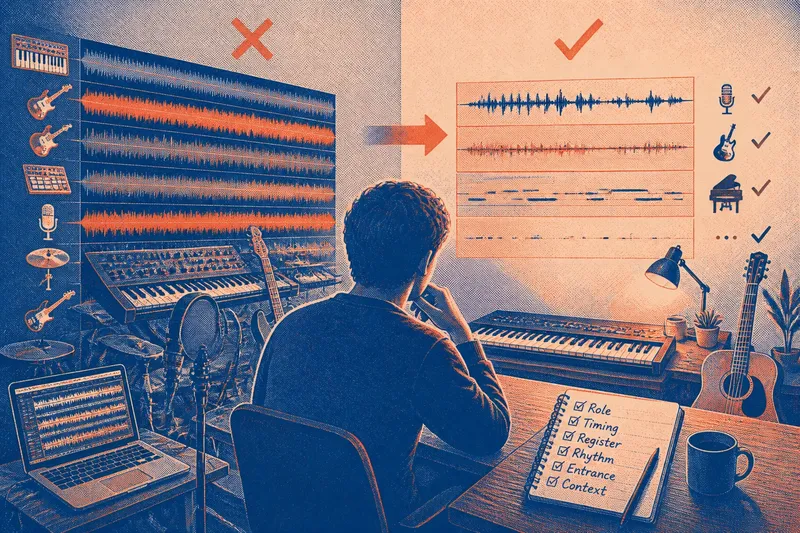
You add a bright keyboard line to a guitar-and-vocal demo, then a second guitar, then a soft pad. The track sounds busier, but the melody is harder to follow. More instruments do not always make a richer sound; a part earns its place by adding a clear role, useful contrast, or a detail the existing arrangement cannot provide.
What makes an arrangement feel rich?
A rich arrangement gives the listener more than one kind of information without making every part compete for attention. That information might come from a steady pulse, a memorable melody, a sustained background tone, or a small rhythmic reply between vocal lines. The parts can be few or many; what matters is whether their roles remain distinct.
Start by naming what each sound does. “Keeps time,” “carries the hook,” and “answers the singer” are useful descriptions. “Makes it fuller” is less useful on its own because it does not explain what the part contributes or when the listener should notice it.
Then ask whether the new part changes the arrangement in a way you can hear. It may add a contrasting texture, support a transition, or give a section a different character. If its only effect is to make the same moment denser, it may be covering something rather than enriching it.
How do I tell if parts are competing?
Parts often compete when they demand attention in the same way at the same moment. Two melodic lines may both use quick, prominent notes. A chordal keyboard and strummed guitar may both fill the same rhythmic spaces. Even different instruments can blur together if their phrasing, range, and timing are too similar.
Listen for practical signs: the vocal becomes harder to understand, the hook loses its shape, or you cannot tell what the added part is doing without isolating it. Competition is not always a reason to delete a track. It is a reason to decide which part leads and which part supports.
Try changing one relationship at a time. Have the keyboard hold a note while the guitar plays a moving pattern. Let a backing line enter after the vocal phrase rather than alongside it. If both parts need to remain active, give them different registers or rhythms so the listener can follow their separate gestures.
When should I remove a layer?
Remove or mute a layer when it has no distinct job, makes a more important part less clear, or repeats information that the arrangement already communicates. A useful test is to mute it during playback and notice what changes. If the section becomes easier to follow without losing its character, the part may not be helping.
Also check whether the part serves only one moment. A quiet cymbal swell or a brief harmony can earn its place by shaping a transition, even if it contributes little elsewhere. The question is not whether every instrument plays throughout the song, but whether each entrance and exit has a reason.
Say you have a vocal, acoustic guitar, and a piano part that repeats the guitar’s chords in the same rhythm. Imagine muting the piano and hearing the vocal and guitar become easier to follow, while the section still feels complete. You could leave the piano out, or keep only a few high notes between vocal phrases; the observable goal is a clearer vocal with a small piano detail that now stands apart.
How can contrast create space?
Contrast lets a listener notice changes without requiring another continuous layer. A verse can feel intimate when one instrument carries the rhythm, then open up when a second part enters for the chorus. A busy phrase can sound more vivid after a pause. Silence and restraint are arrangement choices, not empty spots that must be filled.
Look for contrasts in timing, duration, and activity. One instrument can sustain notes while another plays short attacks. A bass line can move while the upper parts hold a chord. A backing vocal can appear only on the final phrase. These differences create space because each part leaves room for the others to be recognized.
It is not worth adding a track simply because a section feels plain for a moment. First check whether the plainness helps the next entrance land. If the passage needs more character, try changing the existing part’s rhythm, articulation, or entrance before adding another instrument.
What should I listen for before adding another part?
Listen to the arrangement in context, not only to the new sound in isolation. A part can sound attractive when soloed yet distract from the song once the full group plays. Focus on what the listener can follow: the words, the hook, the groove, and any response that gives the music its character.
- Role: Name the part’s job in a few words. If the role is unclear, revise or omit it.
- Timing: Check whether it fills an important gap or crowds an already active phrase.
- Register: Notice whether it occupies the same musical range as a part that needs attention.
- Rhythm: Compare its pattern with nearby parts. Similar patterns may merge; different ones can create a useful conversation.
- Entrance: Decide whether it needs to play throughout or can appear at a transition, refrain, or vocal pause.
- Context: Mute it in the full arrangement and decide what disappears. Keep it only if that change matters to the music.
Can a sparse arrangement sound complete?
Yes. A sparse arrangement can feel complete when its essential roles are covered and its parts leave room for the song’s strongest details. A singer with a steady guitar pattern may need no extra chord instrument. A rhythm section may provide enough motion while a single melodic instrument supplies the hook.
Completeness is not the same as constant activity. A part can pause while the pulse and melody remain clear. That pause gives the next note a shape and can make an entrance feel more expressive than another continuous layer would.
When judging whether to add instruments, use clarity, contrast, and purpose as your guide. More instruments can widen the arrangement, but only distinct, well-placed parts make that added sound meaningful. Listen again for the role each layer serves, and let the music keep the space it needs.